The Sentence: small hole torn here
Dear Void.
It’s Invasion Day today. It’s no day of celebration. I’m at my desk but my support and solidarity are with those marching to recreate the first Day of Mourning in 1938. I live and work on stolen land of the Gadigal. This is often on my mind as I walk through campus, along Petersham Ridge, which these days means walking past work being done on the University’s buildings. It seems property development is stronger than ever during Covid.
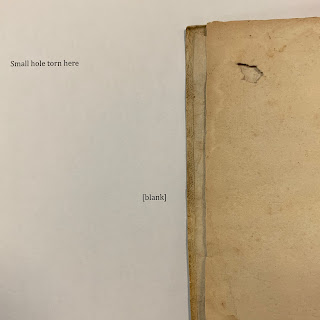 |
| A detail from RBAdd.Ms 35 (folio 1v) |
Today I’m immersed in the words of JL Austin. I don’t know anything else about him other than what I can arrive at via these words. Correction: I did look up his Wikipedia page (thank you, Wikipedia!) and when I looked up ‘descriptivefallacy’ the page pretty much circled back to Austin’s.
I’m doing a slow, slow, slow reading of the text. I have a technique
that gets me into a really productive associative state but it takes time and I
usually have to stop just as I’m getting into a flow because of parenting reasons
and for needing to feed child reasons, and to buy mushrooms on the way home reasons.
Tonight, we’ve made a date to start watching The Godfather Trilogy. Yes, I’ve
made it to the age I am without seeing one. Oh, I know some quotes: ‘go to the
mattresses’, ‘Monday, Tuesday, Thursday, Wednesday.’ But only from watching You’ve
Got Mail (like, a hundred times). So, tonight.
Austin’s style is as you’d expect from a 1950s philosopher of
language, his grammar is perfectly acceptable. I’m enjoying his talk of the revolution
in philosophy that was brought about by scrutiny given to The Sentence. The aforementioned
fallacy is to think that all utterance (sentences) impart straightforward information.
This overlooks the possibilities of the sentence. Ah! The possibilities!
What freedom there is in not treating an utterance as a logical proposition. Let
there be more of it!
I haven’t said much about the commonplace yet, have I? I did mention briefly the object of my research in my introductory post. It is a commonplace book that belonged to Lady Mary Wortley Montagu (1689-1762). It is a small manuscript which includes, at the beginning, fourteen maxims that have been attributed (for instance, in The London Magazine or, Gentleman’s Monthly Intelligencer, 1747) to Duc de La Rochefoucault [stet]. But they’ve been transcribed from Aphra Behn’s Englished version of the Frenchman’s Maximes et réflexions morales du duc De La Rochefoucauld. Anyhoo, the maxims include such gems as:
‘We all mistake virtue, tis not courage makes a man brave, nor chastity a woman honest’.
Can I get an ‘amen' on a woman’s honesty not being tied to chastity, thanks!
Anyway, it occurred to me that, for your reading pleasure, The Godfather might have some quotes that have the same tilt at moral truth. So, I Googled and sure enough, here’s one:
It's dangerous to be an honest man.
But I like this one:
A friend should always underestimate your virtues and an enemy overestimate your faults.
Stay honest, void. And don’t go stealing people’s land.

Comments
Post a Comment