Going back over my research journals (2019)
Dear Void,
In my third week of the doctorate, way back in July 2019, I was driven by an excessive enthusiasm. I wanted so badly for my doctoral project to work, and I had NO idea how it would.
I fancied I might
become an expert in journaling, or in the difference between journaling and
commonplacing (keeping a commonplace book). That seemed to be topical and, for want of a better word, useable. Lots of blogs had already made note that the digital era presents new, 'easy to access' ways to note, or keep track of, your influential quotes, to aid in ‘ways to live well’ and that these
seemed similar to commonplacing. There were comparisons with Evernote, Notes app, any and all ways to manage information and to become 'freakishly productive'. Here's one, that I quite like, as an example.
Not many of the blogs
go deep into the ways of commonplacing. It's a complicated method of reading and meditating and rereading and, hopefully, writing and reading &c. It's deeply personal, as meditation is, and has its roots in Ancient practices of self-improvement as outlined by Michel Foucault in his essay, 'Self-Writing'.
And when you look
deeper into it, the analogies between new digital tools and paper versions break down around the ideas of going deep into
textual material, as opposed to simply keeping a list of witty quotes to pepper
your conversation with in order to appear worldly and learned (said the way Homer
Simpson would).
In 2019, I didn’t yet know what
a commonplace book was, really. Part of the research was to find out. Part of the research was to find out how this particular one came to be here in Sydney.
For my own study routines, I made notes to myself about my strategies for being focused, I wanted to turn up to the work consistently and daily. I made schedules, I watched videos about time management, keeping effective filing systems. I was watching 'organisation porn'. Very satisfying.
I knew I would keep a daily research journal and now that I read back over it I can see that it was a mashup of forms: a logbook, a collection of links, flashes of ideas (I made note when these ‘flips’ came from outa nowhere while I was doing, or writing, other things). This is NOT commonplacing.
In that first period of research, I was typing up the handwritten text from the manuscript into a clean digital copy. It was difficult to keep to this task bc as I came across an unfamiliar word or name, I'd check online for references or consult Isobel Grundy’s biography and I would get carried away into historical (vertical) or biographical (horizontal) realms. Fine, except I really wanted to stay close to the material presented by the manuscript: its body, its fabric, the text without context. Impossible. It was all too dreamy! ‘I love where this takes my mind,’ I wrote on 23 July 2019.
There are pages of Latin text at the back of the manuscript and I tried my best to transcribe these without having any Latin at all.
'Idea: in the style of Julie & Julia
learn Latin like the 12-year old Lady Mary?'
I wasn’t aware of this (until reading back),
but as early as July 2019, I mention that it would be good to try to learn
Latin in order to translate the pages myself. ‘Find a Latin unit to enrol in.’
And perhaps I should approach it as Julie Powell approaches Julia Child’s Mastering
the Art of French Cooking (Louisette Berthole. Simone Beck, Julia Child,
1961): ‘365 days. 536 recipes. One girl and a crappy outer borough kitchen.’
In 2002, Powell had
blogged her entire project, which led to publicity, which led to a book, which
led to a movie, which I watched in July 2019. The reason I’m so surprised to
see that I’d mentioned this in my research journal is that just recently I watched
the movie again (on high rotation) and had finally read the book (which I’d
bought years ago in an op shop and had sitting on my bookshelf all that time).
Well, the book is a delight! I also bought the audible version which Powell
reads herself. And I’m happy to report she sounds just as she ought. I often
have her in my ear on the bus to or from campus. She’s like a comfortable,
funny (hilarious, actually) friend. Telling me about her day. Over and over again.
Now this might seem a
folly or a very unserious topic, and not the sort of subject worthy of PhD
level consideration. Au contraire, my good fellows, here's a thing:
When Lady Mary Wortley Montagu was a young girl, she was determined to learn Latin ‘without a master.’ Her younger brother, Edward, perhaps assisted in this project since he had access to formal training and she had not. Though she did have access to her father’s library.
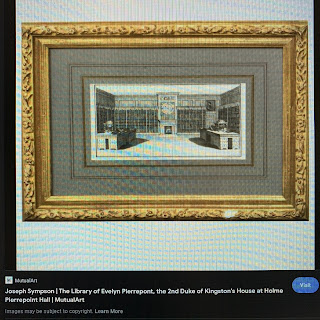 |
| Nice, huh?! You can buy a framed engraving of the library of Lady Mary’s father, Evelyn Pierrepont, 1st Duke of Kingston-upon-Hull, if you so desire, here. |
Lady Mary’s project
c1700 when she was about 12, (perhaps later) was to self-educate. To dedicate
herself to gaining knowledge through a practice of reading, of learning another
language in order to read works in their original.
And here’s where I’m
making a huge leap. I sense a resonance with Julia Child’s project of learning
French in order to read French cookbooks, to communicate with French market-holders,
to become in line with how she felt herself ‘to be French.’ Through this
study of the language and of the cuisine, Julia Child blossomed into the Julia
Child we know. Through reading and putting into practice Julie Child’s cookbook
(which is more than a cookbook by the way), Julie Powell blossomed into a newness too.
The important thing in this learning is that writing through it is an essential component of the practice to gain knowledge. See? Write a book. Blog. Subsume the material in a social way. That's essential to fine commonplacing.
None of this yet has any
direct bearing on Lady Mary’s commonplace. Except that it is a commonplace. And that there are pages of Latin
(which I still can’t read without the aid of a Latin dictionary). And there’s an inscription
on one of the pages: ‘vade mecum.’ The Latin term for a commonplace book which
translates as 'walk with me'. I know this bc of the unit of Latin I took in Semester 1
2020! But which I probably could have found out by reading Earle Havens’ Commonplace Book:
A History of Manuscripts and Printed Books from Antiquity to the Twentieth
Century, published to accompany an exhibition at the Bienecke Rare Book &
Manuscript Library at Yale University. except I didn’t see it there. I had read Havens’ book but it was taking the Latin classes that allowed the words to come into view.
* * * *
Thanks for listening, Void. It's Friday and I've had a week! Tuesday I prepared for a workshop, Wednesday, the workshop, but was told minutes before the event that I'd be MCing (people don't realise how much psychic energy it takes to MC, esp across two realms, zoom and in-person), Thursday recovered, sort of.
* * * *
Hold the presses! I just did a word search on my research journals and found the VW note:
'In a letter to Violet Dickinson in July 1908, Virginia Woolf wrote that 'I am probably to write about Ly. May Montagu'.
But VW doesn't mention Lady Mary in A Room of One's Own (1928), though does mention Margaret Cavendish and Anne Finch. What happened in the 20 years since planning to write about Lady Mary?
* * * *
So, Void, please pass this advice on to new students:
The big takeaway is: keep track of your research, make it a part of your practice and make sure it's in digital form so you can find it again easily.
Jx

Comments
Post a Comment