Holes in the fabric of time
Dear Void,
Little of the text in Lady Mary Wortley Montagu’s commonplace book can be said to have been made absent-mindedly. The entries take the shape of an extended memory, a store of words to be recalled at a later time. (Here we are now in a later time). On the opening page of Lady Mary’s commonplace, a little lively absence has eked out an existence.
There is a small hole in the title page. Worn in the fabric of the page after nudging against the folded corner edge of the vellum cover over time (about 260 years). An irregular pentagon with a corner edge that repeats the shape of the corner edge of the vellum. An imperfection made from materials rubbing together, damaging the underlying tissue of the object until a bit of it falls away completely; things creating absence within themselves.
And through the hole is revealed the word ‘rea’. It’s not possible to see this in the digitised version online since the page was laying on a black background when photographed. The ‘abyss’ of self-similarity made more complete? In digital form it is a black hole! The peeking ‘rea’ only appeared to me in a photograph I took of the manuscript during one of my visits with it.
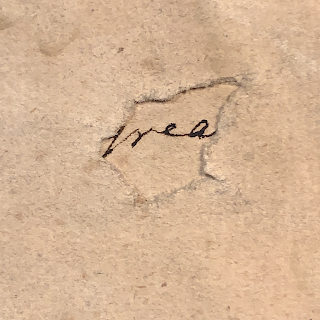 |
| 'a lively little absence has eked out an existence' Detail form Lady Mary Wortley Montagu's commonplace book. |
Today I’m reading Lisa Robertson’s Nilling. Trying to move past the deliciousness of her lines :
I
read garbage, chance and accident. I can't fix what materiality is.
Reading,
I enter a relational contract with whatever material, accepting its
fluency and swerve. I happen to be the one reading (2012:15)
‘Accepting its fluency and swerve’! Yes, please! As I begin to read (scrutinise) her text, I am reminded of my own project. Not only bc our manuscripts have holes in them! But bc I see the way the reader and the manuscript/codex configure, we make a configuration. We join all readers and texts of the past in the act of seeing and perceiving and impressing upon and being impressed upon. We just happen to be the ones reading and being read here and now.
Objects impress upon the senses in an immediate way, which changes with closer inspection. Robertson focuses on one page of the codex which features the lines by Lucretius on how to avoid ‘unhappy love’ and on a little drawing made to border a hole in fabric that creates an imaginative net for someone to espy in the future, or maybe they did it for their own enjoyment?
The drawing appears to be without inherent function beyond being decorative. Things don’t strike the eye but move into view upon examination. Initially, there appeared a Delphic thumbnail, ‘a small ova’ (I want to say ‘ovum’?) that came into view but soon morphed into its true self to attend to the topic, even illustrate it. Perform it. With the promise of Lucretian newness, perhaps?
Nothing is going too badly. I’m taking 2 weeks to get through Nilling AND Seneca Unmasqu’d. Perhaps I should give myself more time? Next week I’m giving a small workshop in Creative Writing for Open Week on campus: I’ll need to set aside time for prepare for that. I’ve been told it should be ‘fun and unintimidating’ so…
Stay fun and unintimidating, Void.
Jx


Comments
Post a Comment