Just like Steinbeck, computer voices & January’s texts
Dear Void,
I want this blog to be an immediate expression of my response to the work of doing arts research. But also, a kind of map. In some way, I take my lead from Steinbeck’s Working Days, his diary of writing The Grapes of Wrath in which he mapped ‘the shapings and seizings, the naked slidings, of his creative psyche.’ Steinbeck wrote the diary 'simply to keep a record of working days and the amount done in each and the success (as far as I know it) of the day.’ He had 7 months to write the book though he thought it might take 5! He wanted the diary entries to be brief and a summary of the actual work of writing a novel. My posts here, though, will be more consciously reflexive. Which is part of my methodology. That’s the aim, anyway. And, as you can see, brevity isn’t a characteristic. Though I want it so much to be.
The text of these
posts can be changed and added to but I won’t go back and change them much: I
want these to be a record of my thinking on that particular day. Maybe I’ll
write about sending poems to journals and getting refused, maybe I won’t. Mostly
it will be me talking to the Void, talking into the Void, like a
character from an elegant Nora Ephron film.
I won’t be
answering ‘why’ I’m doing post grad research on an eighteenth-century
manuscript and making poems and poem-images from that research. That’s material
for my exegesis, which I’m currently taking a crack at. And I’ve had enough of
that ol’ chestnut “Why I Write?’ which is the fallback of every writing unit
everywhere (Didion, Orwell). I wonder if anyone asks Rafa for an essay called
‘Why I Play Tennis?’ But to be honest, there is a bigger question that I’m
keeping in the back of my mind and hope to be able to answer at the end of all
this: ‘why do arts research?’ I’ll get back to you on that one.
Post grad
research, across the disciplines, is an endurance sport. It’s an exhausting,
beautiful and, if you have the privilege of time and space to do the work, a
pleasure. But, yes, yesterday I was a little exhausted. I think it has a lot to
do with the weather, though. Wednesday night, finally, the relentless humidity of
the last couple of weeks broke, in an ecstasy of watery release! Sploosh! It
rained. And overnight, the air was rough and squally and a little cold.
So, I was tired.
When I feel like that I look to the machines for help. I rely on the
text-to-speech function on all my computers (university pcs and my own
macbook). It allows me to push through the material when I’m weary and when my
eyes start to hurt from looking at the screen too long.
Try it out for
yourself. At uni, I prefer to have my document in Word 97-2003 bc it has a
greater choice of voices: I choose Microsoft Catherine, a matter-of fact,
newsreader-y sort of voice, Australian. And on my macbook I have a Scottish
voice called Fiona. I could listen to Fiona all day, and sometimes do.
I’ve finished reading Taussig’s short chapter ‘Mimetic Excess’ and took some time out to watch Les maîtres fous (‘Mad Masters’) which he uses to illustrate how our ‘inherent mental and physical power for representation or imitation of the real world, especially in art and literature’ (the definition of mimesis), ‘speaks for itself’. (Ha! The quote marks, though !!!):
It doesn’t take
long to deep dive into the text of Mimetic Excess. As I said on Wednesday, it’s
a small chapter, the first in Taussig’s book Mastery of Non-Mastery in the
Age of Meltdown. I can’t remember how I landed on this text, it may have
just come up as I searched for something else in the Library’s catalogue. My
research journal tells me I found it on October 29, 2021. Huh. It may have been
bc it cites some text that I’d already been working with. I always make sure to
highlight in the bibliography the references that I’m familiar with and,
especially, already using. Taussig lists in ‘Works Cited’ (207-213): Adorno’s Aesthetic
theory and ‘A Portrait of Walter Benjamin.’ Jane Bennet’s Vibrant
Matter: A Political Ecology of Things which I’ve been using since my
Honours project in 2013, Cervantes’ Don Quixote –Oh, now I remember! It
was when I was reading Cervantes’ preface to the book. It’s a delight.
PS. I highly recommend keeping a research journal. For quickly jotting down where and when you found your material, when you had an idea for something &c. I actually started this blog 2 weeks ago bc I found a note from 2019 that said: ‘start blog re research.’ I’m not a fast worker.
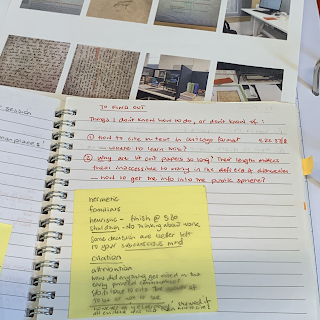 |
| From my research journal (July 2019): hopefully nothing too personal here. Looks like it's just me complaining about the length of humanities papers and we'd just seen Yesterday at the Dendy. Reminder: don't make notes in pencil, it smudges. |
For those following
along at home, the papers tackled in 2022 so far:
JL Austin’s Lecture I in How to Do Things with Words (1955/62) where he proposes the term performative to describe a tricky type of sentence that is an utterance which fulfills its own action and also is the stage for the action, a site for the action.
Michael Taussig’s 'Mimetic Excess' from Mastery of Non-Mastery in the Age of Meltdown (2020)
Next: return to Aphra Behn’s Seneca Unmasqu’d (1680), and Lisa Robertson’s Nilling (2012). Might take 2 or so weeks on these together.
Taussig,
Michael. “Mimetic Excess.” In Mastery of Non-Mastery in the Age of Meltdown.
University of Chicago Press, 2020.


Comments
Post a Comment